Gradora SIOP
A demand planner imports seven extracts from the ERP and the CRM, and leaves with a part-level action list: what to buy, what to build, how much, and by when, under three demand scenarios, with every number traceable to the order or opportunity that produced it. The cycle is then published as a record nobody can edit, scored for forecast accuracy as the actuals arrive, and handed to the finance director as a meeting pack that needs no editing.
01
Every number traces back
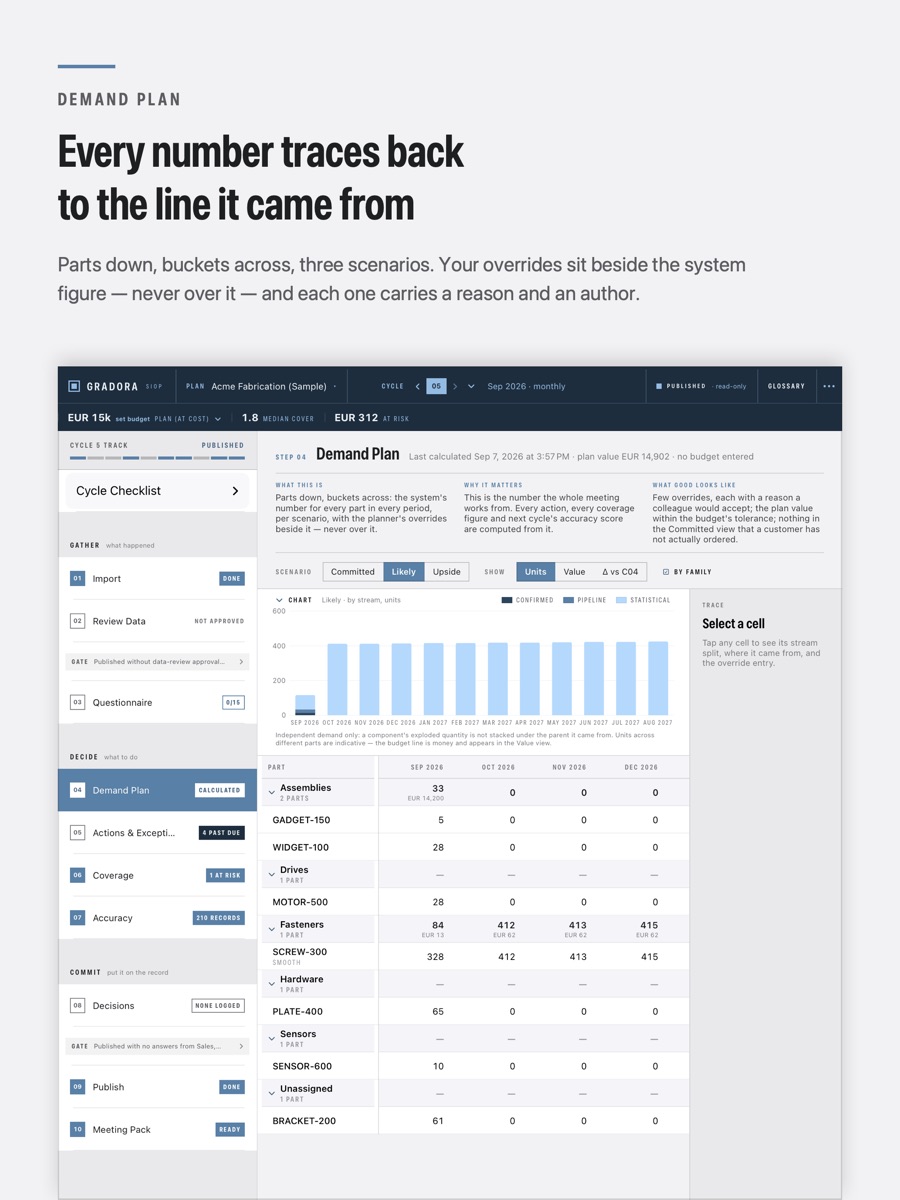
Tap any figure and see its stream split, the rows behind it, and any override with the reason and the person who entered it. A number you cannot trace is a number you cannot defend in the meeting.
02
Published cycles are frozen
Publishing a cycle makes it permanently read-only, enforced in the storage layer rather than by a disabled button. Last month's plan is what last month's plan said, and next month is scored against it.
03
Your judgement is kept, not erased
An override never overwrites the system's forecast. It sits beside it, with a reason and an author, so afterwards you can see whether the planner or the algorithm was closer.
What it looks like
How a cycle runs
A plan is one site: its bucket size, its horizon, its currency and its history. A cycle is one run of the process, usually one month. Every cycle starts working and ends published. Ten steps, in the order the process needs them, grouped into the three phases of a textbook S&OP month.
| Phase | Steps |
|---|---|
| Gather |
Import seven files from the ERP and CRM. Review and correct the rows in place. Ask six departments what changed. |
| Decide |
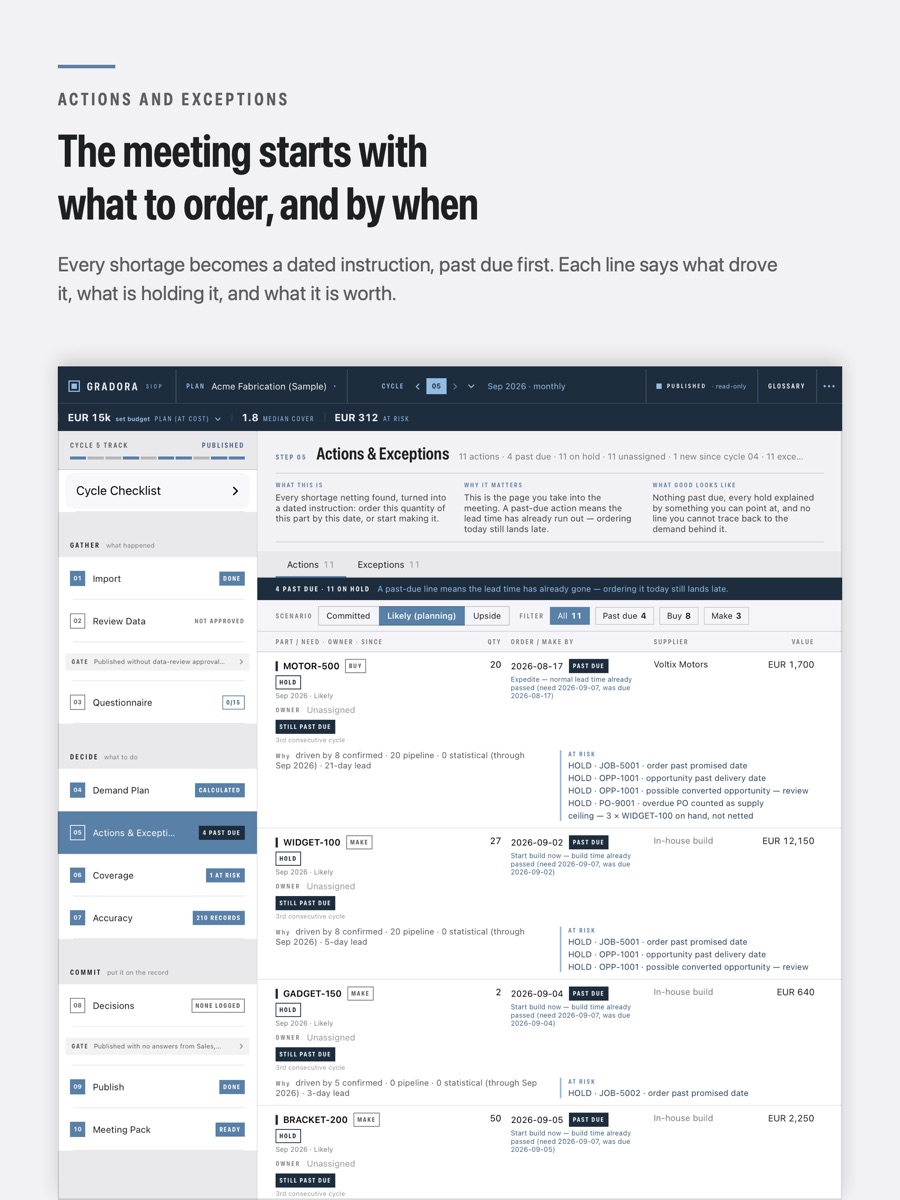
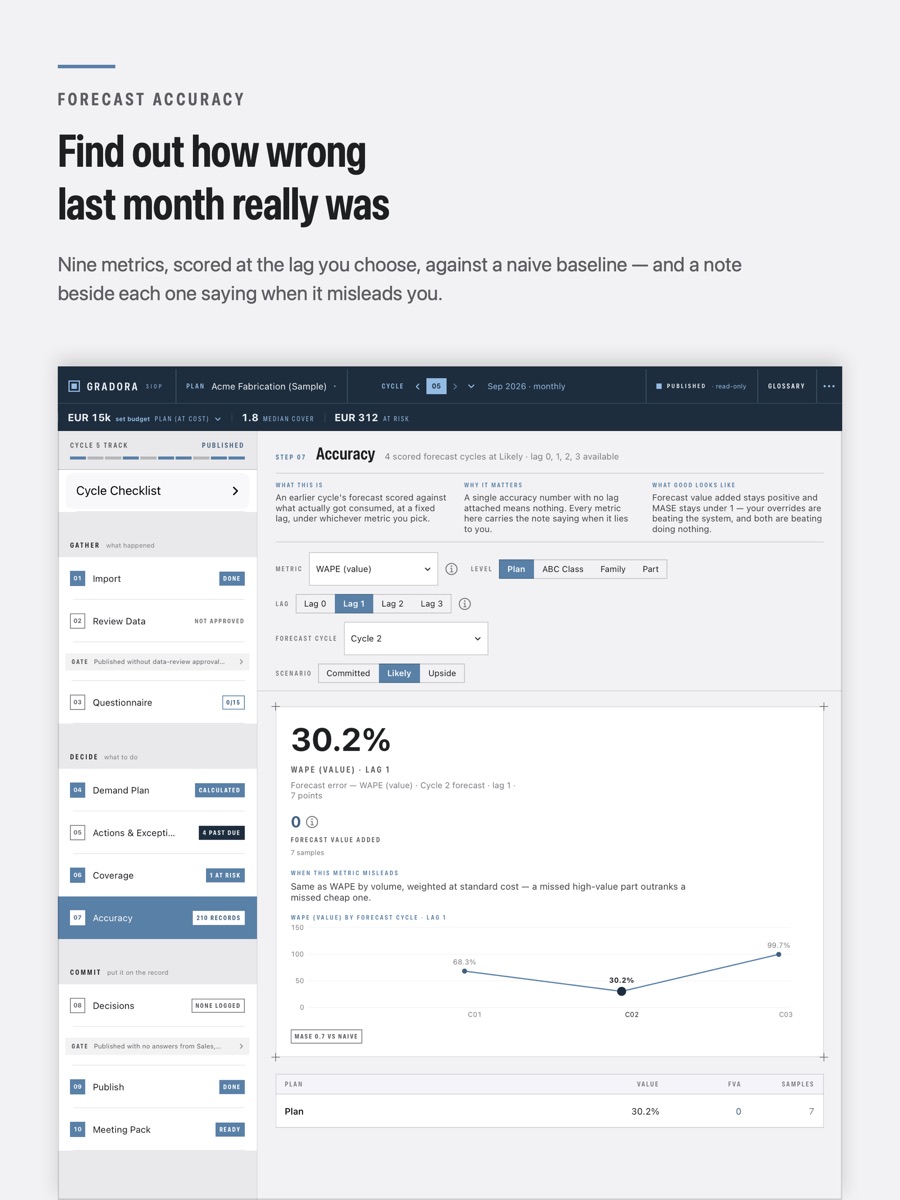
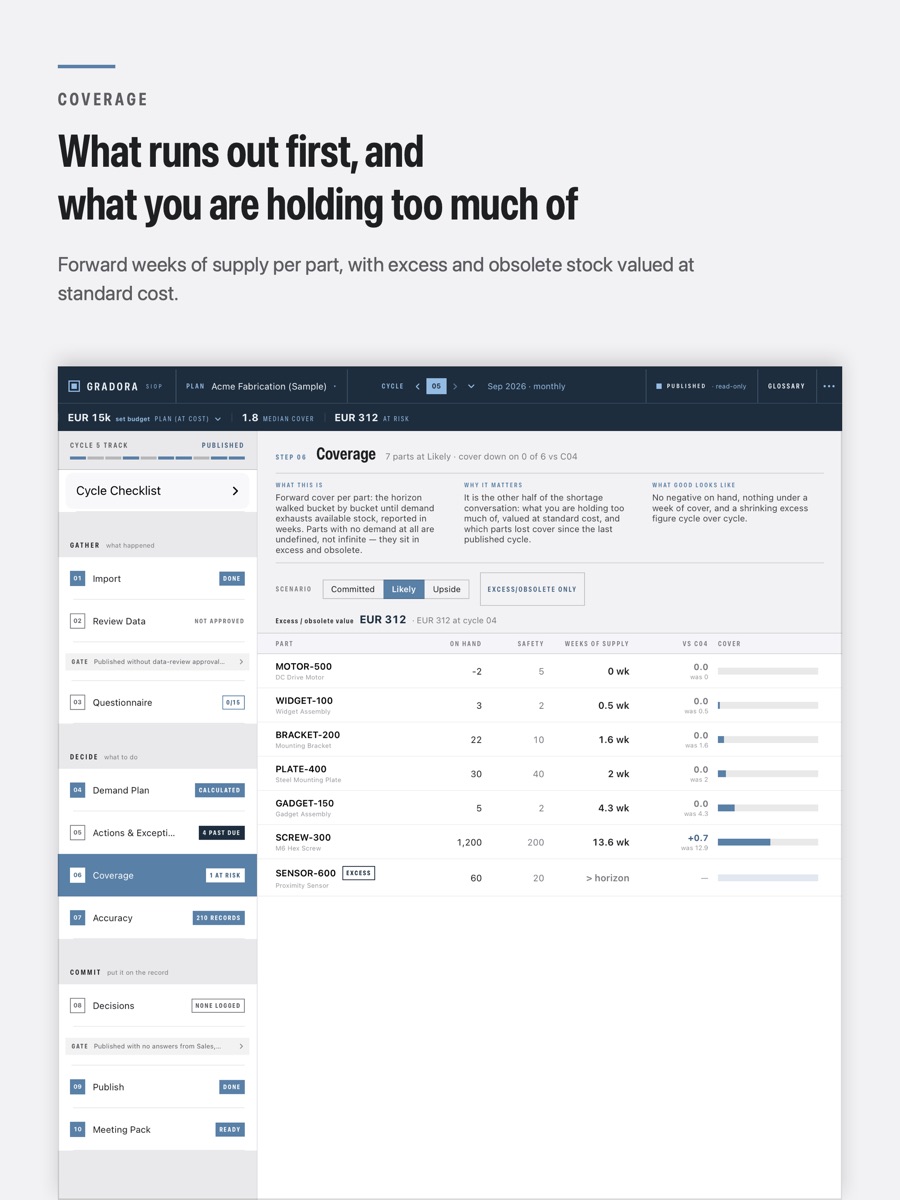
A demand plan across three scenarios with your overrides beside the system figure. A buy-and-build action list with order-by dates, past due first. Coverage in weeks of supply, with excess and obsolete stock at standard cost. Forecast accuracy on nine metrics. |
| Commit |
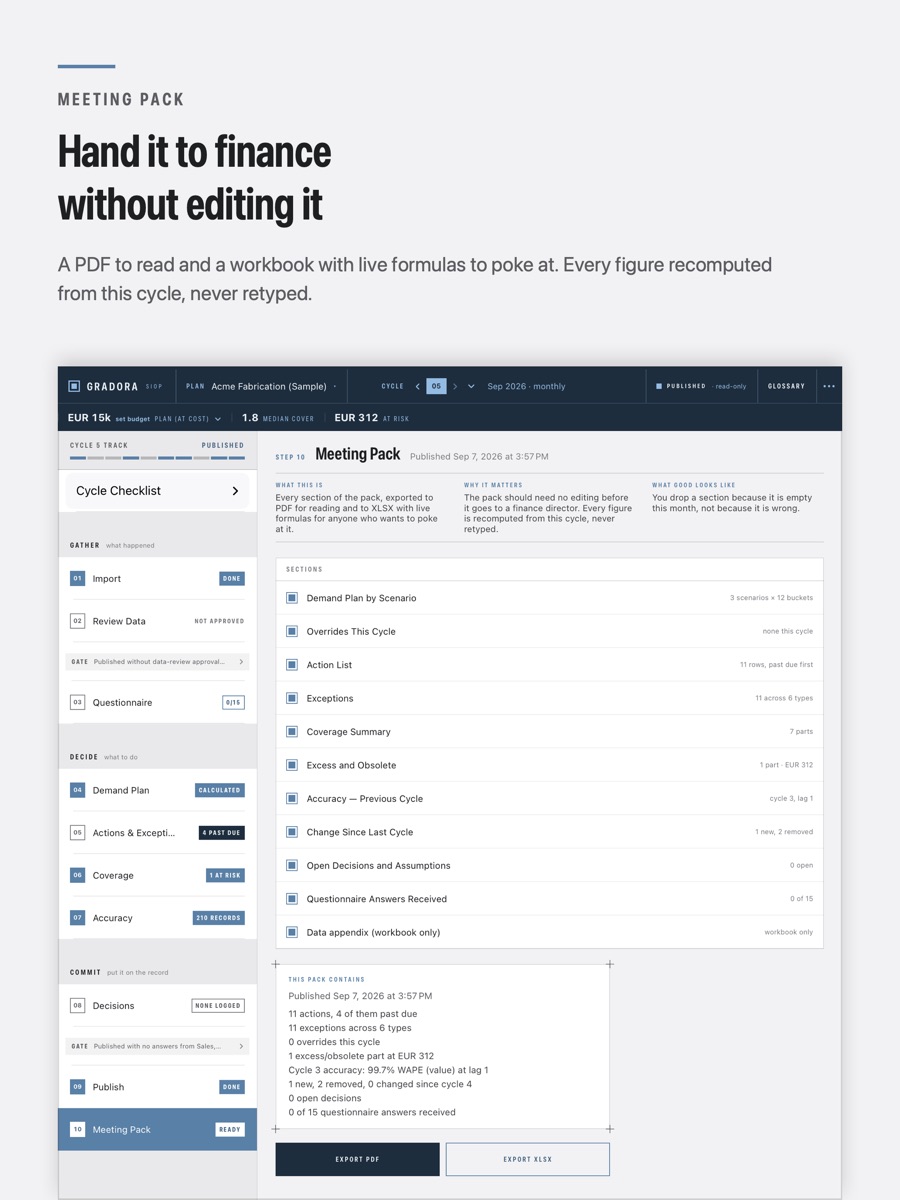
Decisions and assumptions with owners and due dates. Publish, which freezes the cycle for good. A meeting pack as PDF and as a workbook. |
Gates between the phases report what is outstanding — a data review not approved, departments that have not answered, inherited overrides not re-affirmed. Publishing never silently skips one. Whatever is missing is acknowledged by name with a reason, and that acknowledgement prints on the cover of the pack.
The next cycle copies forward the last one's overrides and open decisions, flagged as inherited, so nothing is retyped and nothing is kept without a deliberate one-tap re-affirmation.
What goes in, and what it is not
The seven files
Item master, bill of materials, opportunities, confirmed orders, inventory, open purchase orders and consumption history. CSV, in whatever dialect your ERP writes: the app detects the encoding, the delimiter, the decimal convention and the date order, and refuses to guess on an ambiguous value.
Columns are mapped once per plan and remembered, so cycle two is a five-minute job. Nothing is written until you have seen the preview: accepted rows, rejected rows with the reason, and a hygiene block naming parts with a zero lead time, no supplier, or an order multiple that contradicts the minimum order quantity.
If those extracts do not exist yet, the app writes you a workbook with one sheet per file, every column explained, to hand to whoever writes the ERP report.
What it is not
Being clear about this saves everyone a wasted evaluation.
- One planner, one machine. No sharing, no roles, no multi-user review, no consensus tracking per department. If several planners each need it, each buys a seat.
- Not a capacity planning system. No work centres or hours, no BOM effectivity dates, no phantom assemblies, no alternate parts.
- No ERP connection. It reads files you export. It does not talk to your ERP and never will, because that is exactly the network access it refuses to have.
- CSV in, not Excel in. The app writes XLSX; reading it is deferred until CSV has had a season of real use.
- English only, and one light interface with no dark mode.
There is also a tested ceiling on plan size. Read how big a plan can be before you commit to a site with a very large item master.
What it costs
With a free trial, and volume pricing for organisations buying several seats.
The whole app is free to use on the sample site. Every screen, every calculation and five published cycles of history, with no time limit and no account. A subscription unlocks three things: importing your own data, publishing a cycle, and exporting the meeting pack. Nobody should buy a planning tool they have not first driven.