Apps / Agenda Simulator
Agenda Simulator
A teaching tool for the mathematics of agenda setting. Place voting blocs on a policy map, choose the rule, and the app tells you which positions a majority can be walked to from today's policy, in how many votes, and which coalition carries each one.
What it does
The user places up to eight voting blocs on a two-dimensional policy map, sets a voting rule, and picks a target position. The app then computes whether a majority can be walked from today's policy to that target through a sequence of winning votes, how many votes that takes, and which coalition carries each one.
It is built for university lecturers and students, and for anyone who chairs a committee and has noticed that the order of business decides the result more often than the arguments do.
No account, no sign-in, no analytics and nothing collected. Every part of the app that does the actual work runs on the device and behaves identically in airplane mode: the map, the rules, all 5 proposal-rights modes, the whole analysis and the entire Learn section. The one thing that needs a connection is the App Store, to sell and check the optional subscription.
Where to start
Open the app, tap the book icon, choose Load an example, then The 5-voter example (McKelvey chaos). That is the textbook construction: five voters, no stable outcome, and a three-step sequence of votes that reaches a target far outside anything a single vote could carry.
Watch where it goes. The status quo starts 105 units from the target. The first vote moves to 138 away, the second to 154 away, and the third lands exactly on it. Every step but the last takes the room further from where the agenda setter is steering it, and each one wins a fair majority vote on its own. That detour is the whole point, and it is why the order of business is worth more than the arguments.
What it looks like
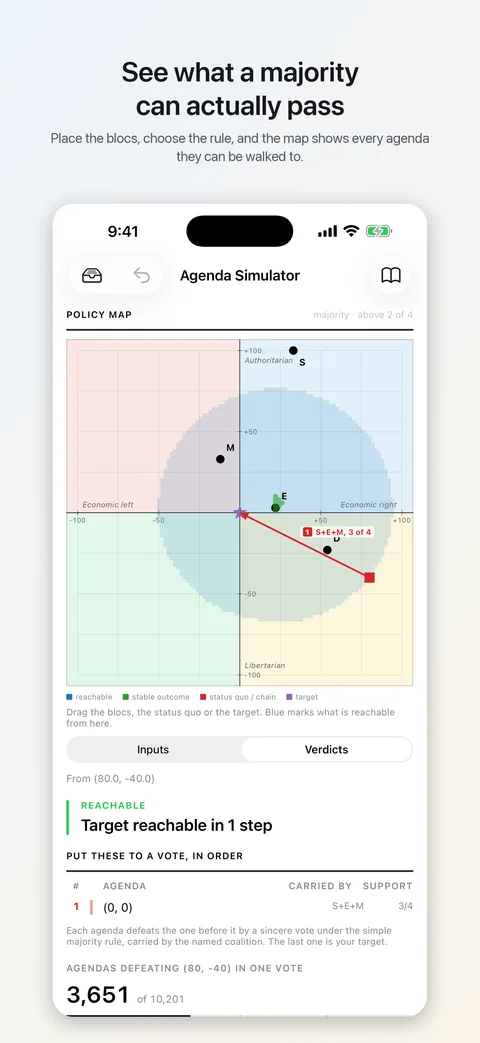
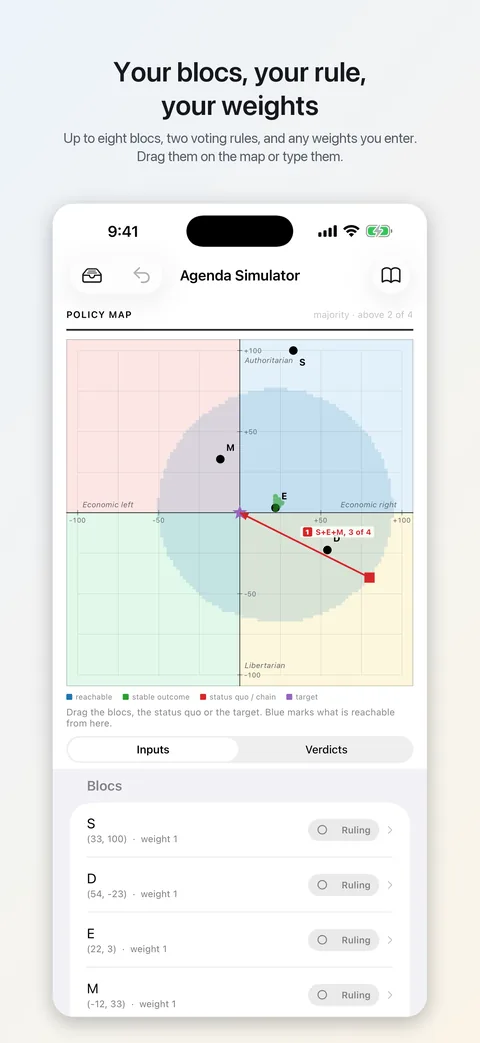
The theory, written up
Short pieces on how these rules behave, each one worked through with real numbers rather than described in the abstract. Everything in them can be reproduced in the app.
| A majority can be walked anywhere The five-voter case above, in full. Three votes, each won fairly, two of which move the room further from the destination. Why the detour is the mechanism and not a trick. | Read → |
| Voting weight is not voting power Two blocs holding twice the votes of a third, and exactly the same power as it. The Banzhaf index with the arithmetic shown, small enough to check on paper. | Read → |
Honest limits
The model assumes four things, and they are strong. Voters are sincere, meaning each one backs whichever proposal sits closer to their own position. They are also myopic: they judge every vote on its own, without looking ahead to where a sequence of votes is heading. The agenda setter knows exactly where everyone stands. And votes cost nothing to hold, so patience is unlimited and the policy space has two dimensions rather than the dozen a real argument has.
Separately, there is a limit on the computation itself. When the app says a target is reachable, that answer is exact: it lists the votes that get there and you can check each one by hand. When it says unreachable, or that a stable position exists, it means nothing was found across a grid of 101 by 101 positions. That is a strong statement, not a proof, and the app labels it as such wherever it appears.
It models the institutional question, not the mass-communication theory of agenda setting associated with McCombs, Shaw, Rogers and Dearing. The Learn section inside the app explains where the two traditions meet.